The Delaware Food Industry Council has provided the best practical guidelines to keep shoppers and grocery store workers safe during the COVID-19 crisis. Please use these helpful safe shopping tips that include several new government mandates.
These simple tips will help provide for a more pleasant shopping experience! For more information, please contact the Delaware Food Industry Council at 302-545-8305.
Recognizing that their states have one integrated regional economy, Delaware Governor John Carney, New York Governor Andrew M. Cuomo, New Jersey Governor Phil Murphy, Connecticut Governor Ned Lamont, Pennsylvania Governor Tom Wolf, and Rhode Island Governor Gina Raimondo today announced the creation of a multi-state council to restore the economy and get people back to work. This announcement builds on the states’ ongoing regional approach to combatting the COVID-19 pandemic.
The coordinating group – comprised of one health expert, one economic development expert and the respective Chief of Staff from each state — will work together to develop a fully integrated regional framework to gradually lift the states’ stay at home orders while minimizing the risk of increased spread of the virus.
Delaware’s representatives will include:
The council will create this framework using every tool available to accomplish the goal of easing social isolation without triggering renewed spread – including testing, contact tracing, treatment and social distancing – and will rely on the best available scientific, statistical, social and economic information to manage and evaluate those tools.
“We still have a situation in Delaware that is getting worse. Infections of COVID-19 and hospitalizations are rising. Delawareans should stay home. Don’t go out in public unnecessarily. Don’t visit Delaware unless you need to see a doctor, or care for a family member. You’ll only increase everyone’s risk,” said Governor John Carney. “At the same time, we need to look forward. We need a consistent approach for moving our states out of this crisis, when that day comes. I’m grateful for the partnership of my fellow Governors in the region. They are all working around-the-clock to prevent surges in COVID-19 cases, protect hospital capacity for the most critically-ill patients, and save lives. We’ll get through this by working together.”
Governor Andrew Cuomo said, “We have been collaborating closely with our neighboring states to combat this pandemic through a uniform approach to social distancing and density reduction and it has been working well. Now it is time to start opening the valve slowly and carefully while watching the infection rate meter so we don’t trigger a second wave of new infections. This is not a light switch that we can just flick on and everything goes back to normal – we have to come up with a smart, consistent strategy to restart the systems we shut down and get people back to work, and to the extent possible we want to do that through a regional approach because we are a regional economy. New York is partnering with these four states to create a multi-state council that will come up with a framework based on science and data to gradually ease the stay at home restrictions and get our economy back up and running.”
Governor Phil Murphy said, “No one has given more thought or is more eager to restart our economy than I am, but if we don’t get the sequencing right, we put more lives at risk. The only path to a sustainable economic recovery is through a strong healthcare recovery. Then, and only then, do we position ourselves to fully ignite our economy and get the residents of our state back to work while minimizing the danger of this disease. A coordinated, regional approach, informed by a multi-state council of experts, will help us avoid a major setback with potentially disastrous consequences. I look forward to the day when the facts on the ground allow us to ease our restrictions and move our regional economy forward.”
Governor Ned Lamont said, “One thing that’s undeniable is that this virus does not stop at the border of any county, state, or country, but the impact is the same when it comes to our respective economies and healthcare systems. Working as a regional coalition to make the right decisions will lead to the best public health results for all of our residents. We must solve these problems together.”
Governor Tom Wolf said, “Our highest priority remains protecting the health and safety of Pennsylvanians. While my administration continues to take critical steps to mitigate the spread of COVID-19, I also recognize that we must look ahead and take a measured, careful approach to prepare for the future while ensuring that we don’t undo all of our efforts. Pennsylvania will work collaboratively with our partners both in state and in surrounding states to develop a comprehensive strategy that first focuses on health but also addresses the need to gradually restore our economy.”
Governor Gina Raimondo said, “States are taking the lead as we fight to slow the spread of coronavirus and save lives. I’m proud of the steps we’ve taken, and I’m constantly thinking about what it will take to safely reopen our economy. But we know that this virus does not recognize borders, and it’s clear we need a strong, coordinated regional approach to avoid a second wave of this disease. I’m grateful to my fellow governors for their leadership during this crisis and I’m confident that this new partnership will support our efforts to get Rhode Islanders — and all Americans — back to work safely.”
Delawareans with questions about COVID-19, related to medical or social service needs, should call 2-1-1; or 7-1-1 for individuals who are deaf or hard-of-hearing. Hours of operation are 8 a.m. to 9 p.m. Monday through Friday; and 9 a.m. to 5 p.m. on the weekends. Questions may also be submitted by email at DPHCall@delaware.gov.
DPH will continue to update the public as more information becomes available. For the latest on Delaware’s response, visit: de.gov/coronavirus.
The Delaware Division of Public Health (DPH) is announcing two additional fatalities related to coronavirus disease 2019 (COVID-19) and is providing an update on the number of positive cases and recovered individuals.
DPH is now reporting deaths of laboratory-confirmed individuals and deaths involving “probable” cases where the individual had clinically consistent symptoms and was exposed to a confirmed case, but was never tested before their death. This new guidance comes from the Centers for the Disease Control and Prevention (CDC).
In total, 35 Delawareans have passed away due to complications from COVID-19. The most recent deaths involve a 33-year-old female resident of a long-term care facility in Sussex County who had underlying health conditions and an 88-year-old female resident of a long-term care facility in Sussex County who had underlying health conditions. Individuals who have died from COVID-19 ranged in age from 33 to 96 years old.
To protect personal health information, DPH will not confirm specific information about any individual case, even if other persons or entities disclose it independently.
The latest Delaware COVID-19 case statistics, cumulatively since March 11, include:
*Data on negative cases are preliminary, based on negative results reported to DPH by state and commercial laboratories performing analysis.
DPH epidemiologists are transitioning to a new data reporting system. During the transition period, not all fields (county of residence, sex) have complete information.
The Department of Health and Social Services’ Division of Public Health and Division of Health Care Quality also released revisions today to the Friday, April 10, announcement of positive cases and deaths in Delaware care facilities, including long-term care facilities. The revisions are:
No facilities have reported staff deaths related to COVID-19.
Delaware is considering patients fully recovered seven days after the resolution of their symptoms. Three days after symptoms resolve, patients are no longer required to self-isolate at home; however, they must continue to practice strict social distancing for the remaining four days before returning to their normal daily routine.
Widespread community transmission is occurring throughout the state, which means COVID-19 is actively circulating in the community. If you are sick with any of the following symptoms, stay home: fever, cough, shortness of breath, sore throat, muscle fatigue, or digestive symptoms such as vomiting, diarrhea, abdominal pain or lack of appetite. If you are sick and need essential supplies, ask someone else to go to the grocery store or the pharmacy to get what you need.
If you think you have been exposed to someone with COVID-19, or have symptoms of illness, make sure to distance yourself from others, particularly vulnerable populations. Older adults and people of any age with serious underlying medical conditions – including serious heart conditions, chronic lung conditions, including moderate to severe asthma, severe obesity and those who are immunocompromised, including through cancer treatment – might be at higher risk for severe illness from COVID-19.
Statewide testing at standing health facility testing sites require a physician’s order or prescription to be tested (*Bayhealth patients will be pre-screened via phone without needing to see a provider first). These are not walk-in testing sites. Those without a primary care provider can call the DPH Call Center Line at 1-866-408-1899. In New Castle County, individuals can call ChristianaCare at 1-302-733-1000 and Sussex County residents who do not have a provider can call the Beebe COVID-19 Screening Line at 302-645-3200. Individuals awaiting test results, should wait to hear back from their medical provider. The DPH Call Center does not have test results.
Anyone with a question about COVID-19, whether related to medical or social service needs, should call Delaware 2-1-1; or 7-1-1 for individuals who are deaf or hard of hearing, or text your ZIP code to 898-211. Hours of operation are 8 a.m. to 9 p.m. Monday through Friday; 9 a.m. to 5 p.m. Saturday and Sunday.
In addition, the Division of Public Health asks any Delaware health care, long-term care, residential, or other high-risk facility with questions or concerns to email: DPH_PAC@delaware.gov or call the DPH Call Center at 1-866-408-1899 and press ext. 2.
Questions can also be submitted by email at DPHCall@delaware.gov.
DPH will continue to update the public as more information becomes available. For the latest on Delaware’s response, go to de.gov/coronavirus.
A Wind Advisory remains in effect today for the entire area as another round of strong and potentially damaging winds is expected, with wind gusts reaching 40-50 mph.
Winds will diminish later today into tonight. While breezy conditions are expected Saturday through Sunday, wind gust speeds will only reach 20-30 mph.
Another round of strong and potentially damaging winds are possible again Sunday night into Monday. Wind gusts of at least 40-50 mph are expected, with the highest wind gusts for eastern and southern New Jersey, and central and southern Delaware and Maryland.
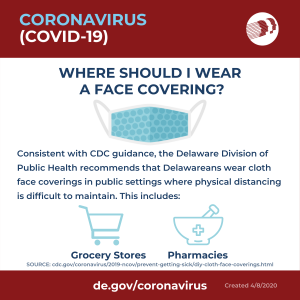
Consistent with the Centers for Disease Control Prevention (CDC), the Division of Public Health (DPH) recommends wearing cloth face coverings in public settings where other social distancing measures are difficult to maintain (e.g., grocery stores and pharmacies). This is a recommendation not a requirement. It is also not a substitute for existing guidance about handwashing and social distancing. It’s important to note that the primary purpose of wearing a mask is not to protect yourself – it is to protect others.
Public Health Guidance:
• The best defense against COVID-19 is frequent hand washing, avoiding being around sick people, staying home/physical distancing, and avoiding touching your face, mouth, eyes, and nose with unwashed hands.
• There may be a benefit to reducing asymptomatic transmission and reinforcing physical distancing through the use of face coverings. However, face coverings may increase risk if users reduce their use of other protective measures, such as physical distancing and frequent hand washing, when using face coverings.
Considerations:
• This guidance is for the use of cloth face coverings only. Members of the general public are not recommended to use medical/surgical masks, as doing so could further endanger critically low levels of personal protective equipment for healthcare personnel.
• Individuals may wear cloth face coverings but should practice strict hand washing before and after touching and adjusting the mask. Face coverings are not a replacement for washing hands, physical distancing while performing essential activities, and staying home.
• If you are sick, you should wear a cloth face covering over your nose and mouth if you must be around other people even at home.
BACKGROUND
What is a cloth face covering?
A cloth face covering is a material that covers the nose and mouth. It can be secured to the head with ties or straps or simply wrapped around the lower face. It can be made of a variety of materials, such as cotton, silk, or linen. Research has shown that certain more densely-woven fabrics may be more effective. A cloth face covering may be factory-made or sewn by hand, or can be improvised from household items such as scarfs, T-shirts, sweatshirts, or towels.
How effectively do cloth face coverings prevent the spread of COVID-19?
There is limited evidence to suggest that public use of cloth face coverings during a pandemic helps reduce disease transmission. The primary role is to reduce the release of infectious particles into the air when someone speaks, coughs, or sneezes, including someone who has COVID-19 but may not show symptoms. Cloth face coverings are not a substitute for washing hands, physical distancing while performing essential activities, and staying home, but they may be helpful when combined with these actions.
When should I wear a cloth face covering?
You are encouraged to wear a cloth face covering when you must be in public for essential activities where it may be more difficult to maintain social distancing, such as shopping at the grocery store. Wearing a cloth face covering does not eliminate the need to physically distance yourself from others. If you are sick you should wear a cloth face covering, over your nose and mouth if you must be around other people even at home.
How should I care for a cloth face covering?
Washing your cloth face covering frequently, ideally after each use, or at least daily is strongly recommended. Use a bag or bin to store cloth face coverings until they can be laundered with detergent and hot water and dried on a hot cycle. If you must re-wear your cloth face covering before washing, wash your hands immediately after putting it back on or adjusting the mask, and avoid touching your face. Discard cloth face coverings that:
• Have stretched out or damaged ties or straps
• No longer cover the mouth and nose
• Don’t stay on the face
• Have any rips or holes in the fabric

Town Hall now has a drop box!
Due to COVID-19 and Town Hall being closed to the public, a drop box was installed in the front of Town Hall (right side of the front of the building). Town employees will check the box several times a day. Any payments that are dropped off after 2:00 p.m. will be deposited the next business day.
Governor John Carney on Monday issued the tenth modification to his State of Emergency declaration, banning all short-term rental units – including vacation home rentals, hotels, motels, and condo rentals – to help fight the spread of COVID-19.
Commercial lodging in Delaware will remain closed through May 15, or until the public health threat is eliminated. The order exempts certain Delawareans and essential workers who may need access to short-term rental units. That list of exemptions includes caretakers with family members nearby, health care providers, journalists, and Delawareans with public housing vouchers.
Victims of domestic violence who need alternative shelter also are exempted.
Monday’s order places additional restrictions on businesses, banning door-to-door solicitation and closing pawn shops, video game stores, and other electronics retailers.
Click here to read the full text of Governor Carney’s tenth modification.
Governor Carney’s updated order takes effect at 8:00 p.m. on Tuesday, April 7.
“All of Delaware’s restrictions are intended to prevent a surge in cases, preserve our hospital capacity, and save lives,” said Governor Carney. “This is not the time for a vacation or tax-free shopping in Delaware. Delawareans also should not go out in public unnecessarily. Stay safe. Stay home. Protect your neighbors. We’ll get through this – but it’s going to take all of us.”
Governor Carney’s emergency order, including its modifications, have the force and effect of law. Failure to comply constitutes a criminal offense. State and local law enforcement agencies are authorized to enforce the provisions of the State of Emergency.
Delaware employers with questions about how they may be impacted can email covid19FAQ@delaware.gov, or call (302) 577-8477 from 9 a.m. to 4 p.m. Emails are encouraged due to potentially high call volume.
Delawareans with general questions about COVID-19 or their exposure risk can call the Division of Public Health’s Coronavirus Call Center at 211, or 711 for individuals who are deaf or hard-of-hearing, from 8 a.m. to 9 p.m. Monday through Friday, and 8 a.m. to 5 p.m. Saturday and Sunday. Questions can also be submitted by email at DPHCall@delaware.gov. DPH will continue to update the public as more information becomes available. For the latest on Delaware’s response, visit de.gov/coronavirus.
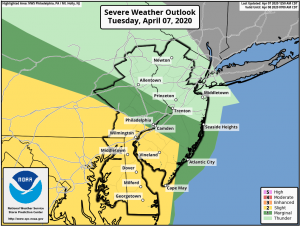
There is a slight risk of severe thunderstorms this evening into tomorrow morning.
Two rounds of severe storms are possible at this time, with the first of these rounds expected early this evening through about midnight. After a brief lull, another round of storms will be possible in the pre-dawn hours Wednesday morning with storms forecast to move offshore around or shortly after daybreak.
COASTAL FLOOD WARNING IN EFFECT FROM 2 AM TO 10 AM EDT SATURDAY…
* WHAT…One to two feet of inundation above ground level expected in low-lying areas near shorelines and tidal waterways.
* WHERE…Coastal sections of Kent and Sussex Counties in Delaware.
* WHEN…From 2 AM to 10 AM EDT Saturday.
Widespread flooding of roadways is expected with many roads becoming impassable. Some damage to vulnerable structures may occur.
Minor coastal flooding is possible with subsequent high tides on Saturday and Sunday.
A Coastal Flood Warning means that moderate or major tidal flooding is occurring or imminent. Be prepared for rising water levels and take appropriate action to protect life and property. Follow the recommendations of local emergency management officials.
Do not drive your vehicle through flood waters. The water may be deeper than you think it is. You will be putting yourself in danger and your vehicle may be damaged, leading to costly repairs.
Governor John Carney on Wednesday signed the ninth modification to his State of Emergency declaration, further limiting public gatherings and ordering essential businesses to take specific steps to enforce social distancing and fight the spread of coronavirus disease 2019 (COVID19).
Governor Carney’s modified emergency order limits public gatherings to 10 people through May 15, or until the public health threat has been eliminated. For the purposes of the order, public gatherings include weddings, funerals, and related activities.
The order also requires new action from businesses that remain open. Under Governor Carney’s modified emergency order, businesses must:
“We will take action to enforce these restrictions if Delawareans, visitors, and businesses don’t comply voluntarily,” said Governor Carney. “Our goal is to save lives. This is a serious situation and we need everyone to cooperate. Don’t go out in public unnecessarily. If you need to go out, stay away from others. Wash your hands and follow basic hygiene guidance. We’ll get through this, but it’s going to take all of us.”
Read the full text of Wednesday’s order.
Governor Carney’s order will take effect at 8:00 p.m. Thursday, April 2.
Governor Carney’s emergency declaration has the force and effect of law. Any failure to comply with the provisions contained in a Declaration of a State of Emergency or any modification to a Declaration of the State of Emergency constitutes a criminal offense.
Delawareans with general questions about COVID-19 or their exposure risk can call the Division of Public Health’s Coronavirus Call Center at 1-866-408-1899, or 711 for individuals who are deaf or hard-of-hearing, from 8:30 a.m. to 6 p.m. Monday through Friday, and 10 a.m. to 4 p.m. Saturday and Sunday.
Questions can also be submitted by email at DPHCall@delaware.gov.
DPH will continue to update the public as more information becomes available. For the latest on Delaware’s response, go to de.gov/coronavirus.